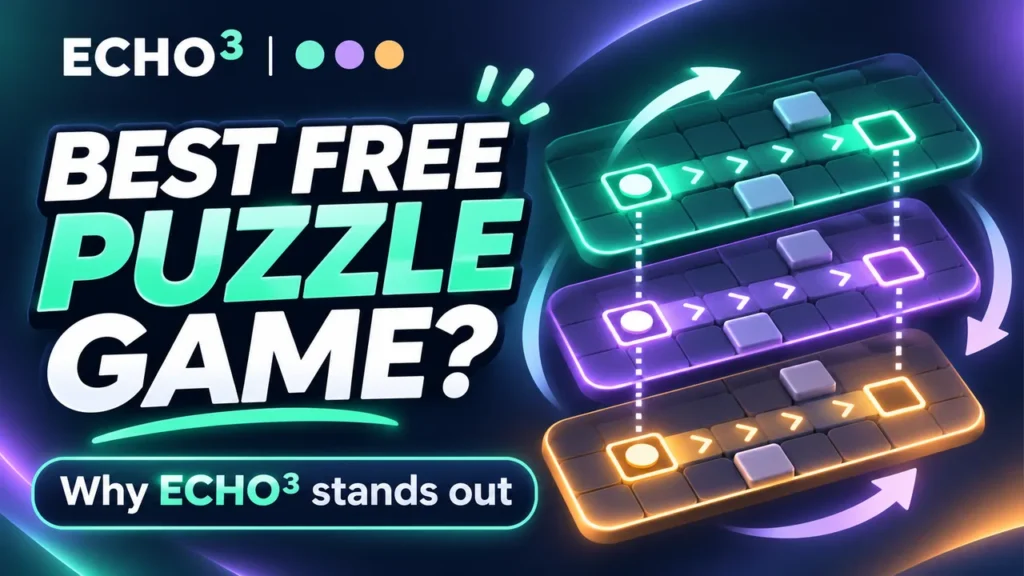
ECHO³ looks like three small mazes, but it is really one shared logic problem. Every arrow affects all three boards at once. Good puzzle solutions depend on predicting those linked movements—especially when one world is blocked, one is mirrored and one repeats what you pressed a turn earlier.
If you have opened the free ECHO³ browser game and wondered why a move that looks helpful on one board ruins another, this guide explains a more systematic way to play. No spoilers for specific level layouts are included. You can work out your own answers with the same basic reasoning used to verify the puzzles.
Image note: The featured artwork illustrates the game’s theme; it is not a screenshot of a player’s result or a guaranteed streak.
First, learn the three movement rules
- NOW: moves in the direction you submit. An Up input tries to move one cell up.
- MIRROR: horizontally reverses the input. Right becomes Left; Left becomes Right. Vertical inputs are unchanged.
- ECHO: moves according to the previous submitted directional input. On the first turn, ECHO waits. On the next turn, it follows the first input.
All three worlds process a turn together. If a character meets a wall or a grid boundary, that character stays still; another character may still move. Even a completely blocked turn counts. Importantly, ECHO stores the submitted direction even if the character that received it could not move.
Strategy 1: identify the exact target in every world
Before pressing anything, locate NOW’s target, MIRROR’s target and ECHO’s target. Mentally note what is immediately next to them. A target beside a wall can be useful because once a character reaches it, you may be able to issue a direction that leaves it in place while moving the other two characters.
Do not stop observing a board simply because its character is currently on the goal. Every later arrow still affects that board unless a wall or boundary prevents the move. The win check happens after a full turn, when all three characters occupy their targets simultaneously.
Strategy 2: translate horizontal arrows for MIRROR
Write down the simple substitution: Left input means NOW-left but MIRROR-right. Right input means NOW-right but MIRROR-left. Up and Down move both of those worlds the same way. When you are thinking ahead, predict the actual action for each board rather than treating the arrow as universal.
This is particularly important when NOW and MIRROR are positioned symmetrically. A Right press may bring NOW closer to a goal while pulling MIRROR away. It can still be the correct move if MIRROR is trapped against a boundary and will stay put. The wall changes the usefulness of the shared input.
Strategy 3: always remember one previous direction
The Echo world has memory. Suppose you submit Up on turn one: NOW and MIRROR try to move up, while ECHO waits. If your second input is Right, NOW tries right, MIRROR tries left and ECHO now tries up—because Up was the earlier input. If your third input is Left, ECHO tries right, following the second input.
That history is why looking only at the current positions is insufficient to predict the next move. Two apparently identical board arrangements can react differently if their previous submitted input differs. The game’s automated solver includes that previous input in each search state for exactly this reason.
Strategy 4: blocked turns are sometimes useful
A blocked move may look wasted, but it can help synchronize the three worlds. Picture NOW parked at the left boundary. Submitting Left keeps NOW in place, while MIRROR may move right and ECHO follows whatever direction you pressed previously. Since Left is still stored for ECHO, the next input will make the Echo character attempt Left.
This technique lets you adjust timing without necessarily changing every board’s position. It is not always part of the shortest solution, but it is worth considering when two worlds seem aligned and the third needs one extra move.
Strategy 5: plan two inputs at a time
Because ECHO is delayed, planning just one arrow can be misleading. Before moving, ask what happens now in NOW and MIRROR, and what ECHO will do from the previous input. Then imagine the input you might press next and its delayed effect. Two-turn planning is often more manageable than trying to predict the whole solution from the beginning.
A handy mental table has three columns: submitted input, immediate NOW/MIRROR response and ECHO’s delayed response. You don’t need to write it down for easy levels, but doing so on paper can help when a puzzle feels impossible.
Strategy 6: use Undo as an experiment
Try a sequence, observe the new positions and compare them with your prediction. If the outcome is worse than expected, undo and identify which assumption failed. It might be a mirrored input, a blocked wall, or the remembered ECHO direction. Experimenting this way is often faster than repeatedly restarting without learning from the result.
In regular level mode, you can work toward a clean solution and then replay to reduce the move count. ECHO³ records personal bests locally. Don’t assume the shortest route is obvious from the number of open cells; the three-board interaction makes some seemingly indirect sequences efficient.
Strategy 7: choose a personal goal before you play
- Learn the rules: solve the level at any move count.
- Improve precision: try to reduce accidental or unnecessary inputs.
- Experiment: find two different valid routes to the same targets.
- Try the daily puzzle: compare your own result with a friend using the shared UTC challenge.
Does solving puzzles make you smarter?
The game offers challenging rule-based problems and satisfaction from solving them, but it has not been clinically shown to improve general intelligence, long-term memory or mental health. The National Institute on Aging advises caution about broad benefits claimed for commercial brain-training games. Enjoy puzzle strategies as skills within the game rather than a guaranteed medical outcome.
Frequently asked questions
Does a blocked move count as a turn?
Yes. Every submitted directional input is a turn, even when one or more characters cannot move. ECHO still records the input for its next delayed action.
Why did ECHO move in an unexpected direction?
It follows the previous submitted arrow, not the previous successful movement of another character. Check the direction you pressed one turn ago.
Do I have to solve all three goals on one move?
All three characters must occupy their targets at the end of the same turn. You may reach one target early, but the final solved state has to satisfy all three boards together.
Can I practice without losing my progress?
Yes, standard levels offer Undo/Restart, and unfinished progress can be restored in the same browser if local site data is retained. You can also revisit How to Play.
Give it a try: Start a beginner level and test these strategies. The game is free to play in your browser.