After a busy day, some people want a quiet, absorbing activity that has a beginning, a clear goal and a satisfying finish. A logic puzzle can fit that mood. You follow a few rules, notice a pattern and gradually solve a small problem. Other people find difficult puzzles irritating. Both reactions are normal.
This article looks at the question behind searches for puzzle games for stress relief: can they help you switch attention away from daily worries, and how can you tell when play is no longer relaxing? We will use ECHO³—a three-world browser puzzle—as an example. It is entertainment, not treatment for anxiety, depression or another mental-health condition.
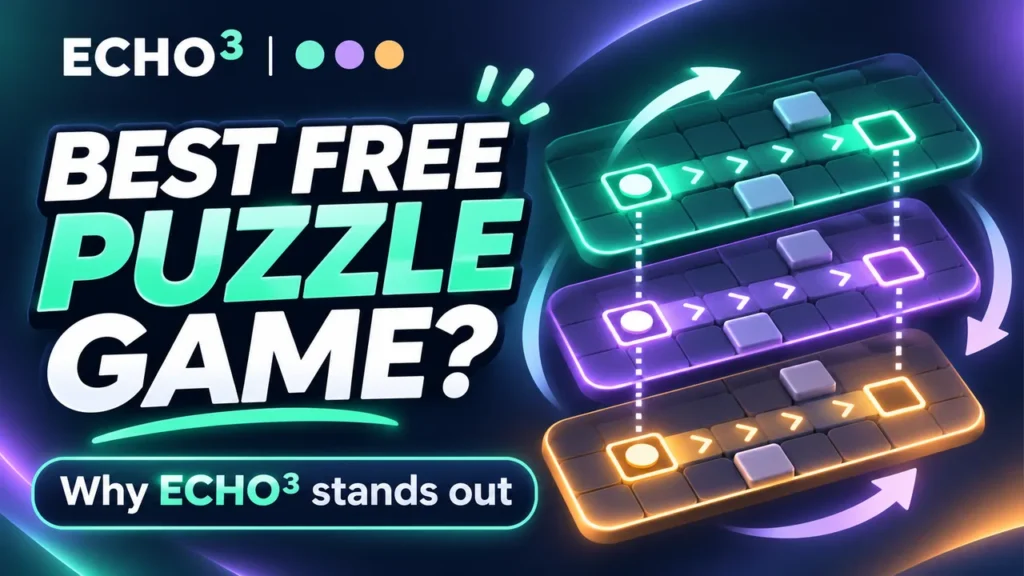
Editor’s note: The featured image is original promotional artwork, not a screenshot of a completed puzzle. Details below describe the playable ECHO³ browser game.
Why a short puzzle break can feel satisfying
A manageable puzzle gives you something specific to focus on: observe the board, choose a move, check the result. Instead of navigating an endless social feed, you decide when to start and when to finish. The sense of progress comes from understanding a rule or finding a route, not necessarily from beating another person.
In ECHO³, pressing one arrow makes three boards respond in different ways. NOW moves with your input, MIRROR reverses horizontal movement, and ECHO repeats the previous submitted direction. If you like calm problem-solving, that predictable rule system may be enjoyable. If you would rather unwind without thinking, the same mechanics may feel like work—and that’s fine.
Do puzzle games medically reduce stress?
It would be inaccurate to promise that this particular game lowers cortisol, treats anxiety or improves mental health. ECHO³ has not been clinically evaluated for those effects. General research on games and wellbeing varies by the type of game, study population and how outcomes were measured. Personal enjoyment is real, but it is not a diagnosis or medical outcome.
A broader lesson from National Institute on Aging guidance is that cognitively engaging leisure activities can be meaningful, while evidence for lasting cognitive effects of commercial brain games is limited. The World Health Organization’s cognitive health guidance takes a wider approach that includes many behaviours and health factors; a game is not a substitute for those.
A low-pressure way to try ECHO³
- Choose an easy level rather than the hardest puzzle on your first visit.
- Allow yourself about five minutes, then decide whether another level sounds fun.
- Turn sound off if you prefer silence.
- Watch how MIRROR and ECHO react instead of trying to play as fast as possible.
- Use Undo or Restart when a solution stops making sense, and stop if the challenge becomes aggravating.
The game saves progress locally in the browser, so you do not have to finish every puzzle in one sitting. You can return in the same browser to Continue Playing if its site data remains stored. That flexibility makes a brief session possible without feeling obliged to clear another level.
When a game break stops being helpful
Short entertainment can become unhelpful if it replaces sleep, crowds out important work, encourages repeated frustration or makes you feel guilty about missing a daily streak. ECHO³ includes optional badges, scores and streaks. Treat these as game decorations, not obligations. Taking a rest day is a sensible choice if that is what you need.
If you are having persistent stress, sleep problems or difficulty functioning, consider support from someone you trust or a qualified health professional. A free puzzle is not a substitute for care. Also remember that more screen time is not necessarily a better break: stretching, walking, social contact or time away from a device may suit you better.
Three ways to enjoy the game without pressure
1. A beginner-level challenge
Try one of the first levels and look for a clean solution. Let yourself experiment with wrong turns. There is no need to chase the shortest possible route immediately.
2. A single worldwide daily puzzle
The ECHO³ Daily Challenge selects a shared puzzle using the UTC date. You can complete the day’s challenge and optionally share your result, without needing a permanent public ranking.
3. A friend-versus-friend logic question
Send a friend the game link and ask how they would handle MIRROR or ECHO. Comparing different routes can be more enjoyable than competing over move counts. Share only when you want to; the puzzle is playable without promotion or an account.
Frequently asked questions
Is ECHO³ a stress-relief app?
No. It is a free browser logic game. Some players may find focused puzzle play relaxing, while others may not. It is not an evidence-based mental-health treatment.
Do I need to log in or install anything?
No. Open the game in a supported browser. Progress is stored on that browser and device, not automatically synced across devices.
Should I play every day?
Only if you enjoy it. Daily challenges offer fresh puzzles, but there is no health requirement to maintain a streak, and you never need to click ads to play.
Ready to try it? Take a short puzzle break with ECHO³. No sign-up or download required.