It is easy to find claims that a five-minute brain game will sharpen your memory, increase intelligence or make you focus better at work. The research is more complicated. Games can be mentally engaging, and practicing a puzzle often makes you better at that puzzle. But improvements on a trained task do not automatically carry over to school, work or everyday memory.
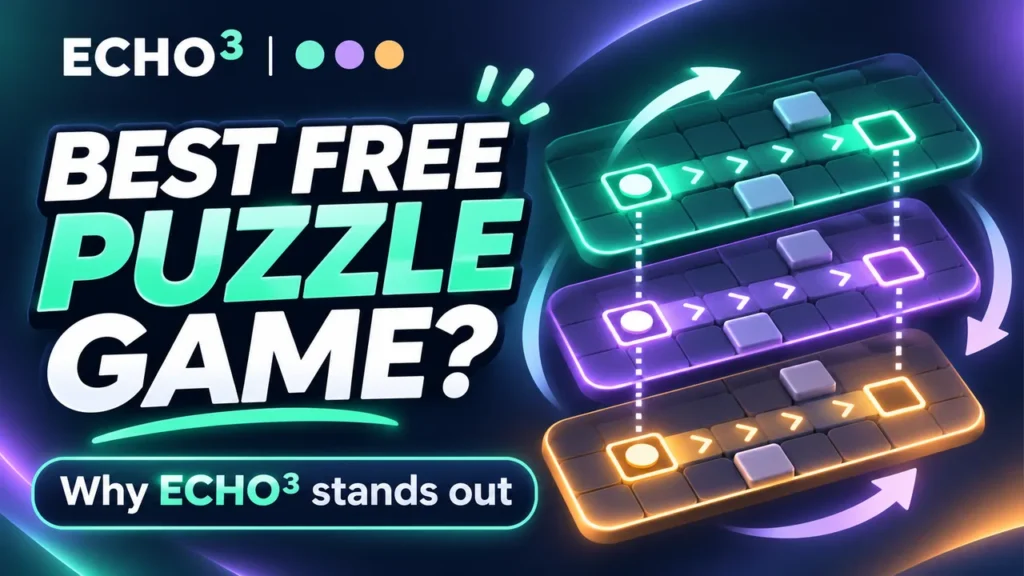
ECHO³ is a free online logic puzzle in which one arrow moves three worlds according to different rules. It is a good example of a game that asks players to hold more than one rule in mind. This guide explains what that experience can offer—and where scientific claims about brain training need to stop.
Editor’s note: The featured image is original promotional artwork, not a screenshot of a completed puzzle. Details below describe the playable ECHO³ browser game.
Focus during a game is not the same as improved attention everywhere
When you play a rule-based puzzle, you may spend several minutes watching positions, testing possible moves and correcting errors. That is attention directed at a clear task. It is tempting to call the experience “attention training,” but a stronger scientific claim would require testing whether play changes attention in other activities, using appropriate control groups and follow-up measurements.
The National Institute on Aging’s cognitive-health guidance makes this distinction. Specialized cognitive training has been studied in large trials, but the agency warns that there is not enough evidence to assume commercially available computer brain-training apps produce the same broad benefits.
What scientific research actually supports
A 2021 systematic review and meta-analysis of randomized studies involving older adults with cognitive impairment found that brain gaming was not significantly better than comparison interventions for overall cognitive function in the pooled results. That result is not proof that puzzles are useless; it does show why promotional claims about guaranteed memory improvement are unsound.
The World Health Organization’s 2026 cognitive health guidelines consider cognitively stimulating activities—including reading, puzzles and games—as part of a wider picture of healthy ageing. Evidence quality varies by intervention, and cognitive health is influenced by much more than a browser game: sleep, physical activity, health conditions and social participation matter too.
What makes ECHO³ mentally engaging?
- Rule switching: you need to remember that MIRROR reverses left/right but not up/down.
- Working with a delay: ECHO uses the previous submitted direction, even if the previous move hit a wall.
- Planning ahead: a move useful in NOW may be harmful in MIRROR, so you compare several possible consequences.
- Error correction: Undo and Restart make it easy to test a hypothesis and try a different sequence.
These are descriptions of the game mechanics, not proof of a transfer effect to professional concentration or clinical memory. You can simply enjoy the satisfaction of understanding a tricky rule and solving a puzzle.
A practical five-minute puzzle routine
- Start a beginner level at ECHO³ Play Now. Read each goal before pressing anything.
- Predict what each board will do for your first two directional inputs.
- Make one move, then compare the actual positions with your prediction.
- Use Undo if you want to try another route; treat mistakes as information.
- Stop after a few minutes if the game becomes frustrating, distracting or interferes with what you meant to do.
Another option is the Daily Challenge. Because the day’s puzzle is shared worldwide, you can compare move counts with friends without creating a public profile. Set your own limit rather than chasing a streak at the expense of sleep or real responsibilities.
What about ECHO³ points, badges and rewards?
Virtual Signal Points, earned badges and theme unlocks can make personal progress visible. They are optional game feedback, not a scientific measurement of intelligence, attention, memory or emotional wellbeing. A better personal goal is to ask whether you enjoyed the challenge and learned a new solution strategy.
What can support cognitive health beyond gaming?
For long-term wellbeing, no single mini-game substitutes for established habits. The NIA describes evidence around physical activity, managing chronic conditions, social engagement, meaningful activities and adequate sleep. If you are worried about persistent memory or concentration changes, a qualified healthcare professional can assess causes that a game cannot.
Frequently asked questions
Will ECHO³ permanently improve my focus?
That has not been established. ECHO³ has not been clinically tested to show lasting improvements in attention, memory or mental health. It is a logic game meant to be enjoyable and challenging.
Can children and adults play?
The rules are simple enough to learn quickly, but later puzzles are more demanding. As with other screen activities, use age-appropriate supervision and take breaks when needed.
What is the best way to start?
Open How to Play ECHO³, try a few beginner levels and give yourself time to understand the MIRROR and ECHO rules before chasing a fast score.
Sources and further reading
- US National Institute on Aging: Cognitive Health and Older Adults.
- Systematic review of brain gaming in older adults with cognitive impairments.
- WHO guidelines on reducing cognitive decline and dementia risk (2026).
Ready to try it? Try ECHO³ as a free logic challenge. No sign-up or download required.